The Astronomy Picture of the Day for September 24, 2026 showcases five fading supernova remnants, captured in stunning detail, highlighting cosmic ghost clouds.
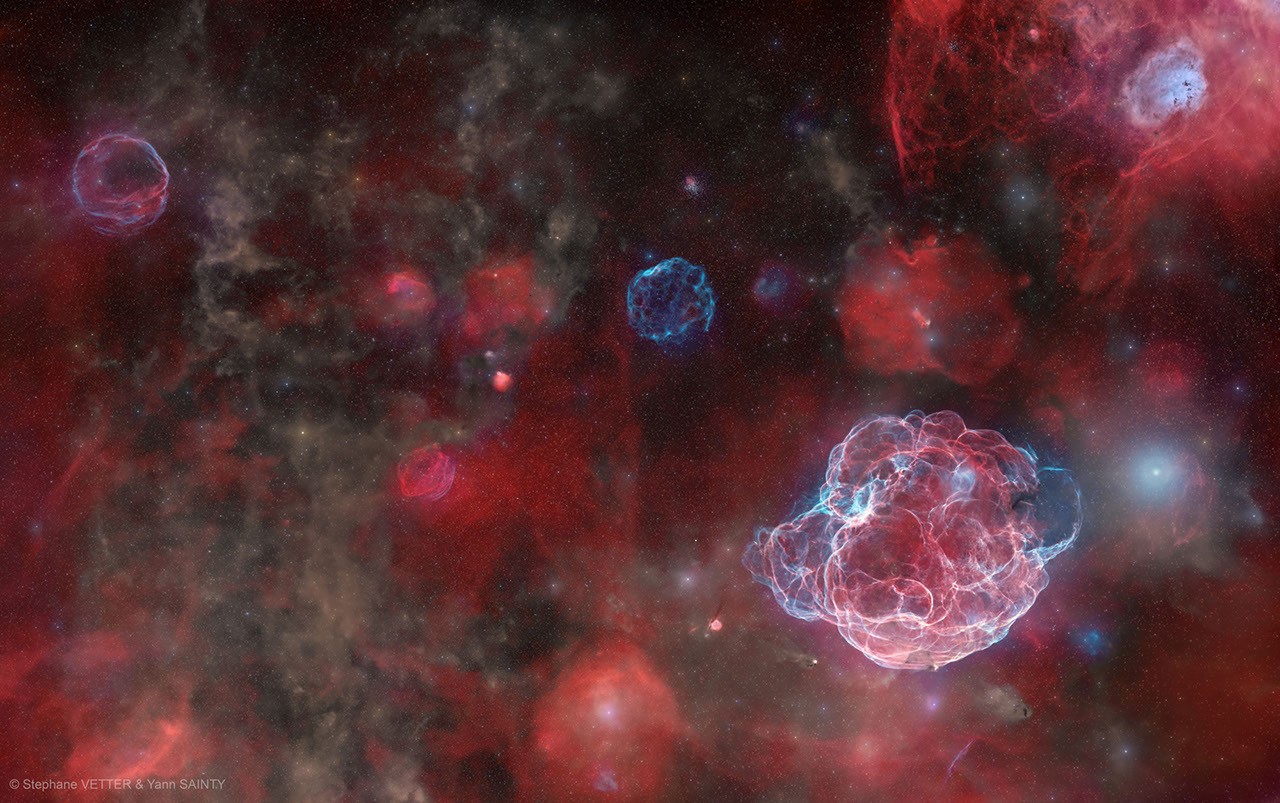
The Astronomy Picture of the Day released September 24, 2026 features an image titled “The Ghosts of Five Supernovas” that reveals the fading remnants of five exploded stars.
According to the Astronomy Picture of the Day (APOD) released on September 24, 2026, the image was captured with a telescope whose specific instrument is not disclosed.
What the image shows
The photograph displays five diffuse, cloud‑like structures scattered across a dark background of interstellar space. Each ghostly nebula glows faintly in hydrogen‑alpha emission, indicating that ionized gas still lingers after the original explosions. The remnants vary in size; the largest spans roughly 15 light‑years, while the smallest measures about 4 light‑years across.
Scientific significance
Astronomers use such remnants to study how massive stars enrich the galaxy with heavy elements. The five objects appear to belong to different age groups, ranging from a few hundred to several thousand years old. By comparing their expansion rates, researchers can refine models of shock‑wave propagation and particle acceleration.
Dr. Elena Ramirez, a senior researcher at the Institute for Cosmic Studies, said the composite view offers a rare chance to examine multiple supernova remnants in a single field of view. She added that the image may help calibrate distance‑measuring techniques that rely on the brightness of expanding shells.
Public response
Social‑media users shared the picture widely, noting its eerie beauty and the reminder that stellar death fuels new star formation. Amateur astronomers expressed interest in locating the same region with backyard equipment, though they acknowledged the faintness of the structures.
The APOD team plans to release follow‑up observations later this year, potentially using spectroscopic data to identify the chemical composition of each ghost. Until then, the image stands as a visual testament to the cycles of creation and destruction that shape our galaxy.


0 Comments